


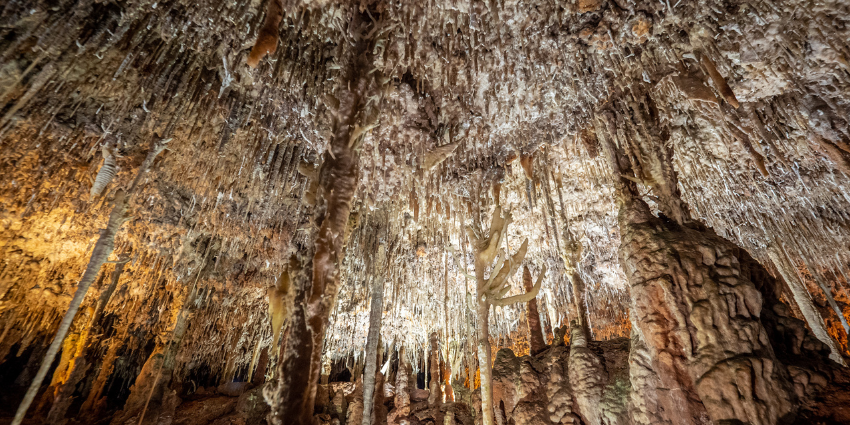
Picture a place where time is measured in droplets. Where every millimetre of rock has taken centuries to form and where the silence holds the memory of processes that began long before the first civilisation ever existed. That place lies beneath your feet, and when you step into a cave like the Cuevas dels Hams in Porto Cristo, you are walking through a natural museum sculpted over more than 10 million years.
The formation of a cave is one of the most fascinating processes in geology. It all starts with something as ordinary as rain. Water falling on the ground absorbs carbon dioxide (CO2) from the air and from decaying organic matter, turning into a mildly acidic solution known as carbonic acid. This seemingly harmless water has the power to slowly dissolve the limestone that makes up much of the Mediterranean subsoil.
Over thousands of years, that steady dissolution carves out cracks, channels and underground galleries. This process, known as karstification, is what creates the karst landscapes found in regions like Mallorca, where Miocene limestoneprovides the perfect conditions. The Balearic Islands are home to some of the most remarkable karst systems in the western Mediterranean.
The outcome of that silent dissolution is not just an empty space. Inside every cave, mineral-laden water keeps working — but now in reverse: instead of destroying rock, it builds it. The truly extraordinary part begins when those droplets, loaded with calcium carbonate, start leaving their mineral imprint drop by drop, centimetre by centimetre, over millions of years.

Stalactites and stalagmites: the art of patience
When a drop of water saturated with calcium carbonate reaches the ceiling of an underground cavity and meets the air, the carbon dioxide is released. That small chemical shift causes the dissolved mineral to precipitate and cling to the rock. Drop after drop, century after century, a stalactite forms — that icicle-shaped formation hanging from the ceiling.
If the drop hits the ground before depositing all its mineral content, the same process repeats at the point of impact. That is how a stalagmite is born, growing upward from the floor. A handy way to remember the difference: stalactite has a “t” for top, and stalagmite has an “m” for mound — because it rises from the ground.
The rate of growth is remarkably slow. In many cases, barely 1 centimetre every 100 years. That means a one-metre stalactite has taken roughly 10,000 years to reach that length. The formations you can admire at the Cuevas dels Hams are, quite literally, works of art that nature has spent millions of years completing.
A one-metre stalactite has taken around 10,000 years to form. The Cuevas dels Hams, with over 10 million years of history, harbour formations that began growing long before the first humans ever walked the earth.
Columns, flowstones and the final fate of a cave
When a stalactite and a stalagmite grow long enough along the same vertical axis, they eventually meet and merge. The result is a column — one of the most striking formations in the underground world. At the Cuevas dels Hams, some of these columns bear witness to geological processes that have run uninterrupted for millions of years.
But nature also leaves traces of its most violent episodes. Some columns appear fractured or displaced, evidence of ancient earthquakes that shook the island and snapped formations that had taken an eternity to join. Those fractures are a reminder that, beneath the apparent stillness of the underground world, tectonic forces remain very much alive.
There is also a little-known yet fascinating concept: the death of a cave. It happens when formations grow so extensively that they completely fill the cavity. The cave is sealed shut by its own creations — a poetic ending in which the very water that opened it ends up closing it with rock. It is a natural cycle that can stretch across tens of millions of years.

The Cuevas dels Hams: a journey through every stage
At the Cuevas dels Hams you can witness all these stages of the geological process in a single visit. From the delicate hook-shaped stalactites — the famous “hams” in Mallorcan, which give the caves their name — to the columns that bridge ceiling and floor, and the extraordinary underground lake known as the Sea of Venice, where live classical music accompanies a landscape forged over millions of years.
The Blue Cave offers a unique visual experience enhanced by a historical documentary, while the Round Caveshowcases especially well-preserved formations. Three different caves in one visit: an exceptional opportunity to see first-hand how water transforms rock into something extraordinary.
If you would like to explore the world of karst formations further and discover how these same geological processes have shaped other parts of Spain, we recommend our article on the karst landscapes and caves of the Murcia region.

Frequently asked questions about cave formation
How long does it take for the stalactites and stalagmites at the Cuevas dels Hams in Mallorca to form?
Stalactites and stalagmites grow at an approximate rate of 1 centimetre every 100 years, though this varies depending on the amount of filtered water, the temperature and the mineral concentration. The formations at the Cuevas dels Hams have taken millions of years to reach their current size, which is why their preservation is so important.
What is the difference between a stalactite and a stalagmite?
The main difference is their position: stalactites hang from the ceiling and stalagmites grow up from the floor. Both are formed by the precipitation of calcium carbonate dissolved in water. When the two formations grow enough along the same axis and meet, they form a column — one of the most impressive structures you can see at the Cuevas dels Hams in Porto Cristo.
What is karstification and why does Mallorca have so many caves?
Karstification is the process by which mildly acidic water dissolves limestone, creating caves, galleries and underground formations. Mallorca boasts one of the richest karst subsoils in the Mediterranean thanks to its abundance of Miocene limestone. This geological process is directly responsible for natural wonders such as the Cuevas dels Hams in Porto Cristo.
Can a cave “die” or stop growing?
Yes. A cave can become completely filled when stalactites, stalagmites and flowstones grow so extensively that they seal the cavity entirely. This phenomenon, known as the death of a cave, is a natural process that can last tens of millions of years. It can also happen that changes in the water table or the absence of water filtration halt the growth of formations, leaving the cave in a state of geological dormancy.