


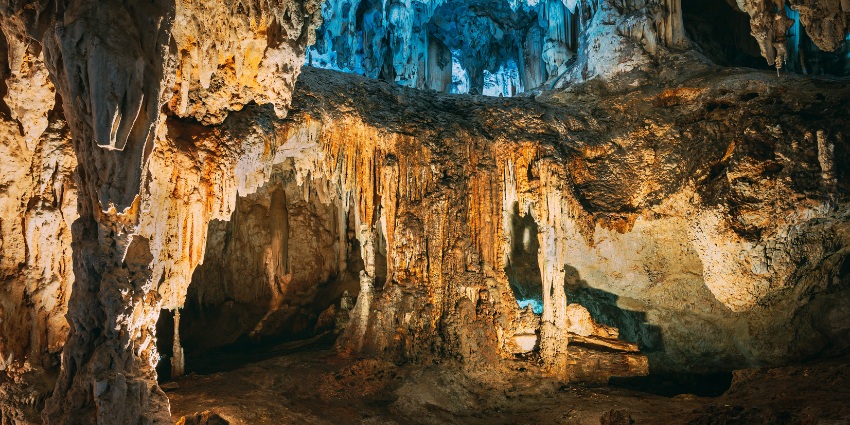
On 12 January 1959, five boys from the village of Maro went out to hunt bats in a sinkhole known as La Mina. When they lowered themselves through a narrow crack, they discovered a succession of enormous chambers that had been sealed for thousands of years. Today, the cave is one of Spain’s most visited natural monuments and one of the few places in the world to bring together colossal formations, an archaeological record spanning more than 40,000 years and a natural auditorium that has hosted a music festival for over six decades.
The Nerja Caves lie on the eastern coast of Málaga, five kilometres from the centre of Nerja and just over an hour from Málaga city. They are best known for their scale. The Hall of the Cataclysm contains a huge column once recognised by Guinness as the largest in the world, measuring around 32 metres high and 13 metres across at the base. What truly makes Nerja unusual within European karst, however, is the way its geology and human occupation sit on top of one another, clearly visible without requiring much imagination.
This article explains what you will see during the visit, why Nerja’s cave art has placed it at the centre of the debate about Neanderthals, and what you should know before buying a ticket: opening times, actual prices, how to get there and the best time of day to go.
How it formed: limestone, sea and millions of years
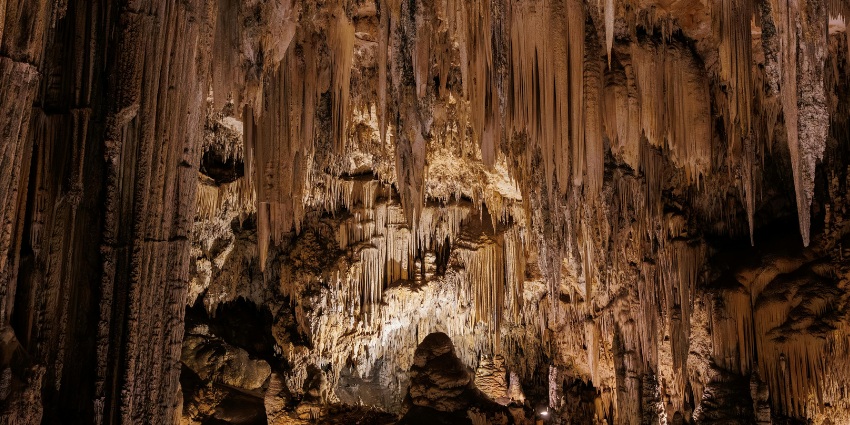
The cave opened in the dolomitic marble of the Sierra Almijara, a metamorphic rock formed from limestone deposited when this entire area lay beneath the sea. Rainwater charged with carbon dioxide slowly dissolved the rock over millions of years, opening passages that later filled with stalactites, stalagmites, columns and flowstone. The process began about five million years ago and is still active. In damp areas, you can see water dripping and continuing to deposit calcite.
Nerja stands out for its vertical scale. Many tourist caves are long and low; here, the chambers rise tens of metres because the system developed along vertical fractures in the mountains. That volume explains both the enormous columns and the acoustics, which allow the Ballet Hall to work as a stage with very little technical amplification.
▸The cave system has a total length of around 4,800 metres divided into three sections. Only one, the Lower Galleries, is open to the public. The Upper and New Galleries are reserved for research and conservation and account for roughly two-thirds of the system.
Cave art: why Nerja changed the debate about Neanderthals
Several hundred painted and engraved motifs have been recorded on the cave walls: abstract signs, rows of dots, hands and animals such as goats, deer, fish and seals. Most date from the Upper Palaeolithic and were made by anatomically modern humans who used the cave intermittently over tens of thousands of years.
The controversial section involves a group of red, seal-shaped signs deep inside the cave. Dating published from 2012 onwards, and later reviewed, placed charcoal remains associated with the paintings as far back as 42,000 years ago. That would predate the documented arrival of Homo sapiens in this part of the Iberian Peninsula. If the link between the dated charcoal and the pigment is confirmed, the images would have been made by Neanderthals, making Nerja one of the strongest pieces of evidence that they produced symbolic art.
The debate remains open and should be presented that way. The dating of the organic material is reliable; what is disputed is its direct connection to the painted marks. Whatever the outcome, Nerja’s archaeological sequence is exceptional. Burials, animal remains, stone tools and evidence of marine food consumption reveal repeated use of the cave from the Middle Palaeolithic to the Bronze Age.
This part of the site is not visible on the standard tourist visit because the painted areas are closed. The route and the museum in the town do explain the context, and it is worth allowing time for that before or after going underground.
What you see on the visit: the main chambers
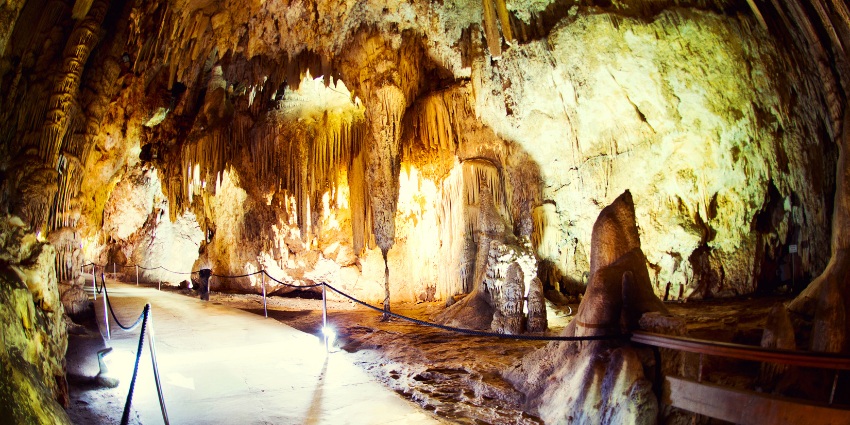
The public route follows comfortable walkways with lighting through the Lower Galleries. At an unhurried pace, it takes around 45 minutes. These are the main stops:
- Entrance Hall. The entrance to the system and the area where much of the human occupation was concentrated. It is less visually dramatic, but it carries the greatest archaeological weight of the accessible route.
- Nativity Hall and Hall of the Ghosts. Forests of stalagmites and narrow formations whose resemblance to figures gave the chambers their names. They are a good example of how lighting affects the way a cave is perceived.
- Hall of the Cataclysm. The highlight. This is where you find the great 32-metre column, formed when a stalactite and stalagmite met, as well as blocks brought down by earthquakes that shook the cave around 800,000 years ago. The name is literal: the floor is the result of a collapse.
- Ballet Hall and Waterfall Hall. The natural auditorium used by the festival. Its acoustics have been exploited since 1960, and it seats around one hundred people.
The temperature stays close to 19–20°C throughout the year, with high humidity. That feels pleasant in summer, while in winter there is no need for a heavy coat. The floor can be damp, so wear closed shoes with a good grip.
Opening times, prices and how to get there
Opening times. The cave opens every day of the year except 1 January and 15 May. In the low season, the usual hours are 9:00 am to 4:30 pm. In summer, opening is often extended until 7:00 pm, with last admission one hour before closing. Times change seasonally, so check the official website during the month of your visit.
Prices. General adult admission is around €15–16, with reduced rates for children aged 3 to 12 and free entry for children under 3. Combination tickets may include the Nerja Museum and a shuttle to the town. Special guided visits to areas that are normally closed have separate prices and limited availability. Nerja residents have their own conditions.
Booking. Entry is organised by time slot. Tickets often sell out in advance over long weekends, Easter and August. Booking the day and time online avoids the main disappointment visitors can face here.
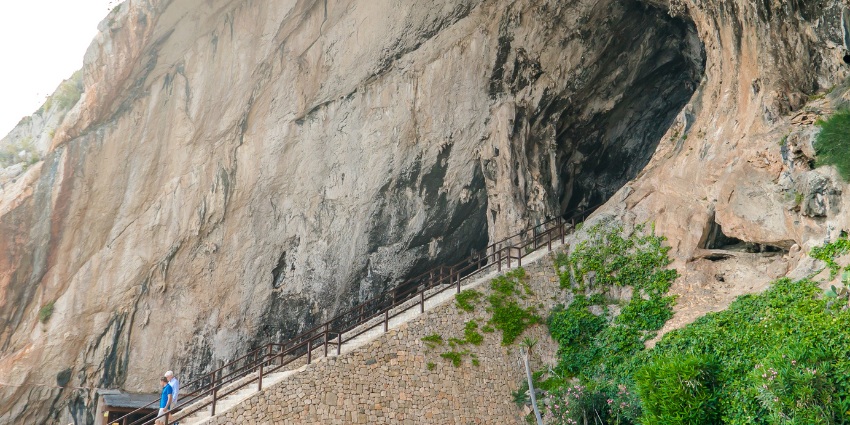
Getting there. By car, take the Maro exit from the A-7. There is a large car park at the cave. The bus route between Málaga and Nerja stops a few minutes away on foot, and a shuttle runs from central Nerja during the high season. The journey from Málaga city is about 55 kilometres and takes a little over an hour.
Accessibility. The route involves around 500 steps on the way down and back up. It is not suitable for wheelchairs and is difficult with a pushchair. Keep this in mind if travelling with very young children or anyone with limited mobility.
When to go. Aim for the first entry of the morning at any time of year and avoid August if you have a choice. Large groups tend to arrive in mid-morning, and the difference in the experience is noticeable.
The festival: a cave with its own sound
Since 1960, only a year after the discovery, the Ballet Hall has hosted the Nerja Cave International Festival of Music and Dance, one of the longest-running festivals in Spain. Its stage has welcomed classical ballet companies as well as flamenco and pop artists. The unusual format is exactly why it works: around one hundred people inside a stone chamber with reverberation no purpose-built auditorium can reproduce.
The trade-off is conservation. Tourist caves are affected by human presence through body heat, carbon dioxide and light, which encourages algae to grow. Nerja has maintained an environmental monitoring programme for years, adjusting visitor numbers, lighting and the event calendar. It is the same tension faced by every cave open to the public: showing it without damaging it.
Frequently asked questions about the Nerja Caves
How long does the visit take?
The guided or self-guided route through the Lower Galleries takes about 45 minutes. Including parking, access and the museum, allow between one and a half and two hours.
Can you see the cave art on the standard visit?
No. The paintings and engravings are in areas closed for conservation. The standard route explains the archaeological context, while some limited-capacity special visits provide wider access.
What is the best time to visit?
First thing in the morning and outside the high season. The temperature inside stays constant all year, so the weather outside does not have much effect on the experience.
Is the Nerja column the largest in the world?
At around 32 metres, it was once recognised as the largest by Guinness World Records. Larger formations exist in caves that are not open to tourists, but among accessible caves it remains one of the world’s best-known examples.
Can you visit with children?
Yes, and it works very well as a family visit. The limitation is physical: around 500 steps make a pushchair impractical and can make the route difficult with very young children.
If you love caves, the Mediterranean has its own version
Nerja impresses through scale and age. In the Balearic Mediterranean, another cave offers a completely different but equally distinctive experience: the Cuevas dels Hams in Manacor. Formed by an ancient underground river, they are known for their eccentric formations, stalactites that grow in seemingly impossible directions and appear to defy gravity. Music is also part of the visit, with live concerts on the underground lake known as the Sea of Venice.
They are two very different ways to understand the world beneath the surface: the monumental scale of southern mainland Spain and the geological delicacy of Mallorca. If you are planning a trip around Spain and caves fascinate you, both are worth seeing.