


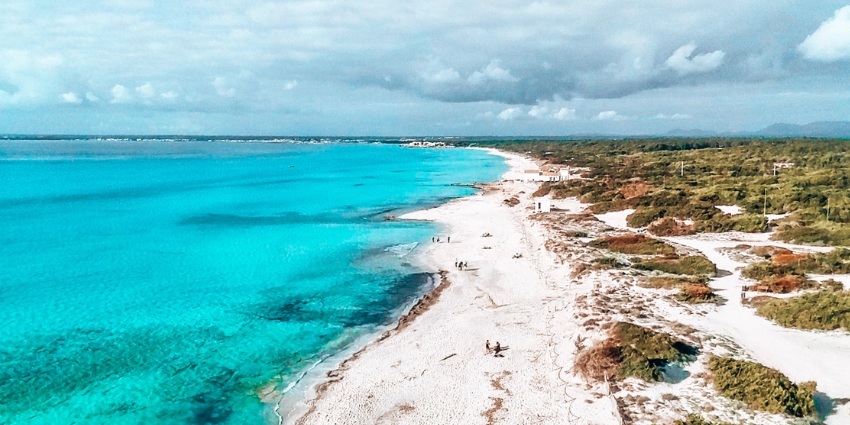
Es Trenc is the beach that Mallorcans consider their own. Not out of exclusivity, but out of habit: for decades it was where island families went when they wanted white sand, clear water and not a hotel in sight. Today it is still exactly that, although with considerably more people.
At almost 10 kilometres long, Es Trenc is the most extensive natural beach in Mallorca. It stretches along the south coast of the island, between Sa Ràpita and the Colònia de Sant Jordi, within the municipalities of Campos and Ses Salines. It forms part of the Es Trenc–Salobrar de Campos Area of Special Natural Interest, a protected space that includes the beach, the dunes, a wetland and the historic salt flats that give the area its name.
What makes Es Trenc different from other beaches in Mallorca is what it does not have: no tall buildings behind the beach, no promenade, no development visible from the sand. What there is, is a strip of dunes covered in vegetation, a wood of pines and junipers beyond, and behind that the salt flats. It is the coastal landscape the whole island had before the tourist boom, preserved here thanks to its protection as a natural area.
The beach: what to expect
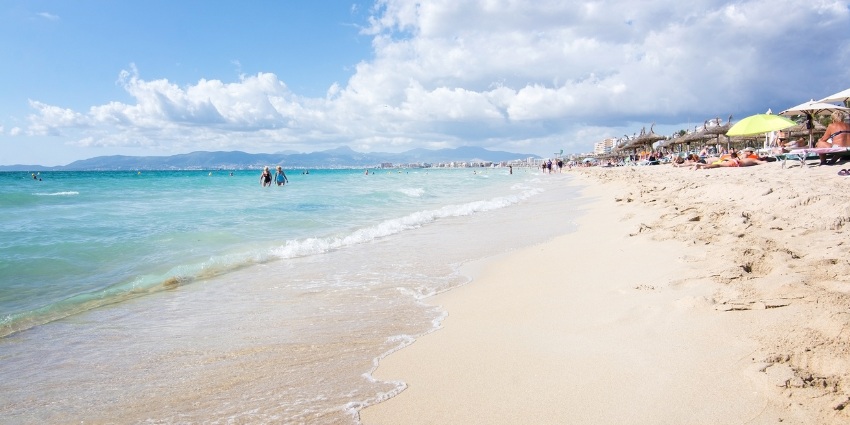
Es Trenc has fine white sand, turquoise water and a seabed that shelves very gradually. At the shoreline, the water barely covers your ankles for many metres, making it a safe beach for children and comfortable for anyone who prefers to swim in shallow water.
The beach is divided into several sections with different names along its 10 kilometres:
Ses Covetes. The western end, closest to Sa Ràpita. It is reached from a small car park and is the most family-oriented section. There are a couple of beach bars and sun loungers available in season.
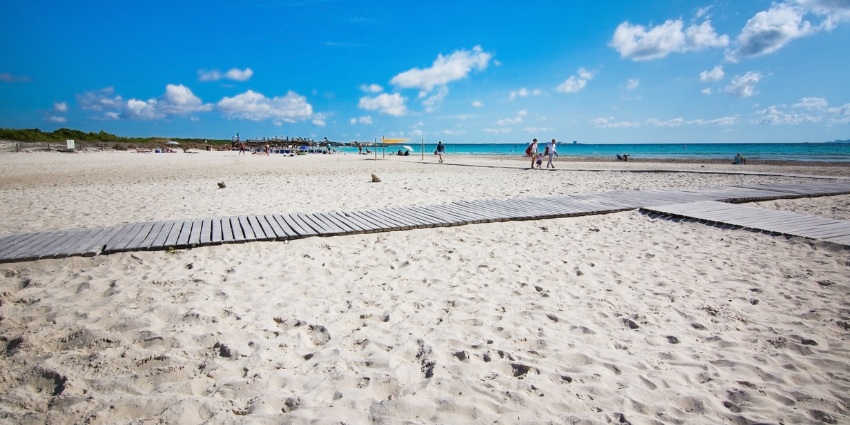
Central Es Trenc. The most extensive and most unspoilt section. It is reached on foot from Ses Covetes or from the salt-flats car park. There are no facilities: no sun loungers, no beach bars, no shade (except what the pines at the back provide). It is also the section where nudism is commonly practised, as noted by Wikipedia.
Es Dolç and Colònia de Sant Jordi. The eastern end, closer to the town of Colònia de Sant Jordi. It has more facilities and easier access.
The water quality is exceptional. The extensive posidonia meadows off the beach (visible as dark patches in the water) help to keep the sand stable and the water clean. Posidonia is not dirt: it is an indicator of a healthy marine ecosystem.
Behind Es Trenc lie the Salinas de Levante, working salt flats that produce more than 10,000 tonnes of salt a year. Their origins date back to the Phoenician and Roman period (4th century BC), making them one of the oldest salt-harvesting operations in the western Mediterranean.
The salt flats: salt since Roman times
Just behind the beach, separated by the dune strip, stretch the Salinas d’Es Trenc: more than 135 hectares of evaporation ponds where sea salt is produced in the traditional way.
The history of these salt flats goes back to the 4th century BC, when Phoenicians and Romans were already exploiting the natural conditions of this area to extract salt. During the Middle Ages, the salt flats were an important source of income for Mallorca’s feudal lords. The current company, Salinas de Levante S.A., was founded in 1958 and since 2003 has marketed Flor de Sal d’Es Trenc, a gourmet salt that has become one of the island’s most recognised food products.
The salt flats can be visited on guided tours that explain the production process and take you around the evaporation ponds, where the colour of the water varies from blue to pink depending on the salt concentration and the presence of microorganisms. It is a visit that combines history, artisan industry and landscape.
How to get to Es Trenc
Access to Es Trenc is not as direct as to other Mallorcan beaches, and that is part of its charm (and its protection).
From Ses Covetes. Drive to the village of Sa Ràpita (municipality of Campos) and from there follow the road to Ses Covetes. There is a pay car park near the beach (7–10 euros in high season). Spaces fill up early in summer.
From the salt flats. Take the turning at kilometre 8.8 of the Ma-6040 road that passes through the salt flats and ends at a dirt car park. From there it is about a 7-minute walk across sand to the beach.
From Colònia de Sant Jordi. The easternmost access. You can walk along the coast from the town (about 20 minutes) or take a shuttle bus in high season.
Important. In summer, parking is the main problem. Spaces run out before mid-morning. It is recommended to arrive before 9:30 or use public transport/bicycle from the nearby towns.
The Salobrar de Campos: the wetland
Between the salt flats and the beach lies the Salobrar de Campos, a wetland that forms part of the natural park. It is an area of shallow water and halophilic vegetation (adapted to salinity) that is home to one of the largest concentrations of waterbirds in Mallorca.
You can see flamingos (especially in autumn and winter), black-winged stilts, herons, cormorants and various species of waders. The Salobrar has several observation points accessible from the paths that border the salt flats.
If after a day at the beach you fancy trying the local cuisine, the Campos area is famous for its culinary tradition. We recommend our article on Mallorcan pork loin with cabbage, one of the most representative dishes of the island’s inland cooking.
Frequently asked questions about Es Trenc
Is Es Trenc a nudist beach?
Es Trenc has areas where nudism is commonly practised, especially in the central section. It is not compulsory: there are textile sections and naturist sections. The two coexist normally and without conflict.
Are there beach bars at Es Trenc?
Yes, but only at the ends (Ses Covetes and the Colònia de Sant Jordi area). The central section of the beach has no facilities at all. Bring water, food and shade if you plan to spend the day in the central zone.
Can you park for free at Es Trenc?
Not in high season. The main car parks charge between 7 and 10 euros. There are some free parking areas further away, but they require a longer walk to the beach.
When is the best time to go to Es Trenc?
May, June and September offer good weather, warm water and fewer people than July and August. In October the water is still at a good temperature and the beach is practically empty. In the height of summer, the main drawbacks are overcrowding and the difficulty of finding parking.