


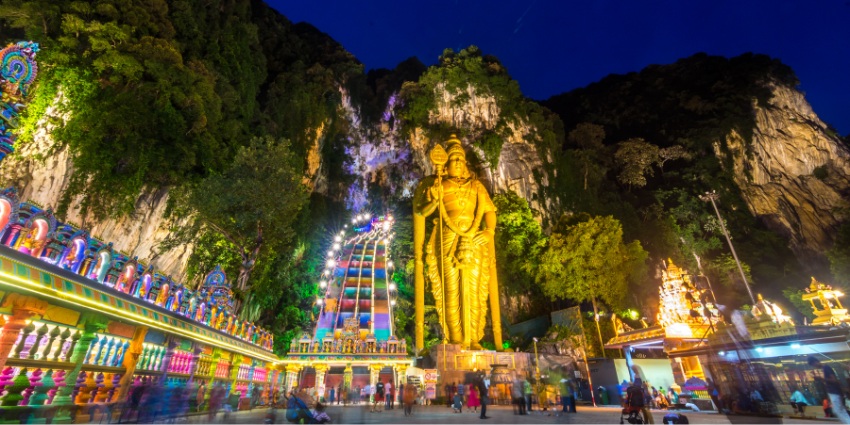
The Batu Caves are one of those geological formations that force you to recalibrate your sense of scale. A limestone massif 325 metres high rising from the middle of the Malay plain, 13 kilometres north of Kuala Lumpur, pierced by a system of more than 20 caves that have been forming for around 400 million years.
But what makes the Batu Caves unique is not the geology alone. It is the combination of nature and spirituality: since 1891, this cave complex has housed the largest Hindu shrine outside India, dedicated to the god Murugan, deity of war and victory in the Tamil tradition. Every year, more than a million devotees and tourists climb the 272 steps leading to the main cave.
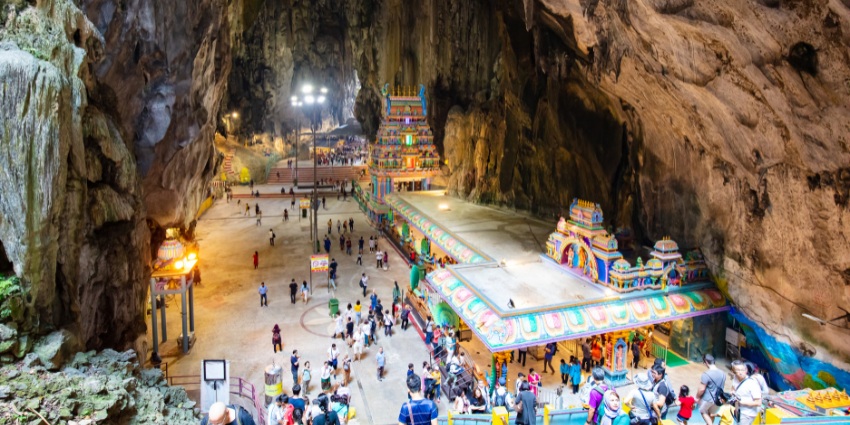
The result is a place where stalactites share space with altars, where monkeys roam among sculptures of gods, and where natural light pours through holes in the cave ceiling to illuminate underground temples with a theatricality no architect could design.
The geology: 400 million years of history
The Batu Caves were formed in a mogote (an isolated limestone hill) during the Devonian period, approximately 400 million years ago. That makes them one of the oldest limestone formations in Southeast Asia, according to Wikipedia.
The formation process is the same as for any karstic cave: rainwater, made slightly acidic by the carbon dioxide it absorbs as it passes through the soil, gradually dissolved the limestone over millions of years, creating ever-larger cavities. Over time, those cavities became chambers of enormous proportions.
The system includes more than 20 recognised caves, four of which are large systems with multiple interconnected chambers. Inside you can see stalactites, stalagmites, flowstones, cave pearls and other formations typical of karstic caves.
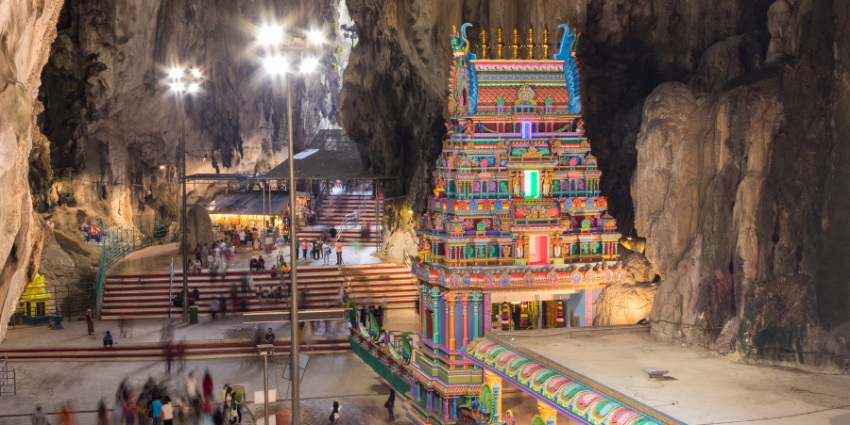
The main cave, known as the Cathedral Cave (or Temple Cave), has a ceiling that reaches 100 metres high at certain points, with natural openings through which sunlight enters. Those openings create shafts of light that illuminate the interior in ways that shift throughout the day.
The Hindu shrine
The religious history of the Batu Caves begins in 1891, when the Indian trader K. Thamboosamy Pillai decided to consecrate the caves as a shrine dedicated to Murugan (also known as Kartikeya or Subrahmanya). Pillai saw in the natural shape of the main cave a resemblance to the vel (the sacred spear) of Murugan and considered the site fitting for a temple.
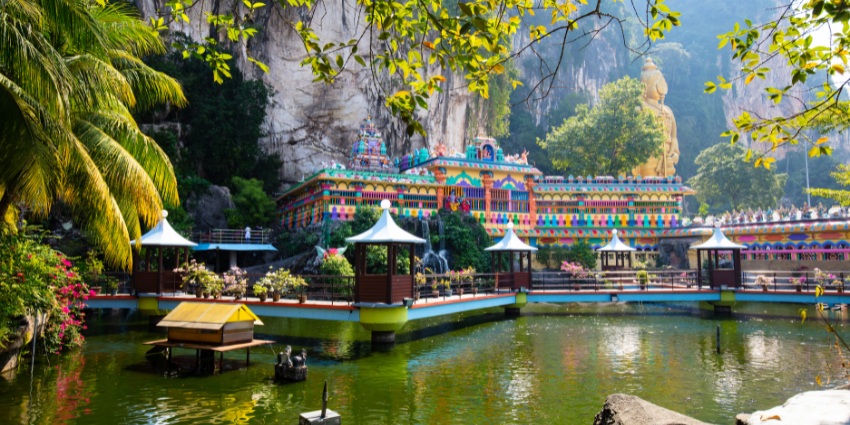
Since then, the caves have become the largest Hindu pilgrimage centre outside India. The complex includes several temples spread across different caves and levels of the massif.
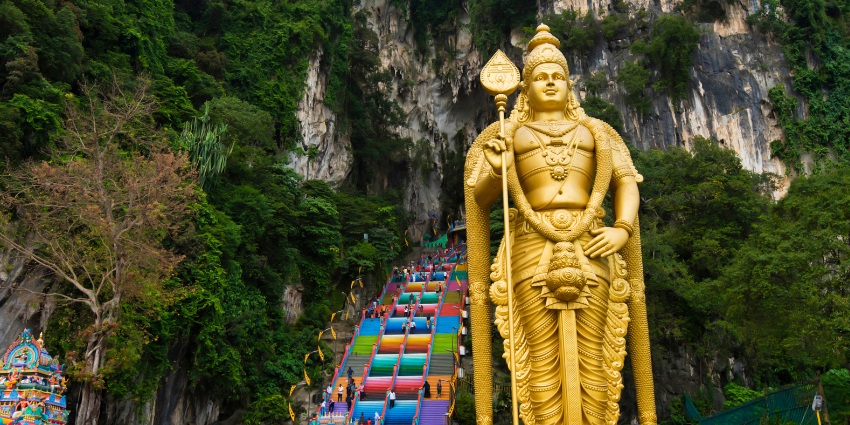
The entrance is dominated by a golden statue of Murugan standing 42.7 metres tall, unveiled in January 2006 after three years of construction. It is made from 350 tonnes of steel and 1,550 cubic metres of concrete and was built by craftsmen brought specially from India. It is the tallest Murugan statue in Malaysia and the second tallest in the world.
To reach the main cave you must climb 272 steps. The stairs, originally wooden when they were installed in 1920, were renovated and painted in rainbow colours in 2018, turning them into one of Malaysia’s most recognisable photo backdrops.
Thaipusam: the festival
The highlight of the Batu Caves calendar is Thaipusam, a Hindu festival celebrated every year in January or February (during the full moon of the Tamil month of Thai). It is a celebration dedicated to Murugan and attracts more than a million people over the three days it lasts.
Thaipusam is known for the extreme devotional practices of its followers: many carry kavadis (decorated metal structures attached to the body by hooks and needles that pierce the skin, cheeks and tongue). It is an act of penance and gratitude that devotees undertake after months of spiritual preparation, including fasting and prayer.
The procession begins at the Sri Mahamariamman Temple in central Kuala Lumpur and covers the 13 kilometres to the Batu Caves, where the devotees climb the 272 steps bearing their kavadis. The visual spectacle is awe-inspiring: thousands of people dressed in vivid colours, drum music, incense and an atmosphere of religious fervour unmatched anywhere in Southeast Asia.
For non-Hindu visitors, Thaipusam is a unique opportunity to witness an ancient tradition in an extraordinary natural setting. Attendance and photography are permitted, although respect for the rituals is expected.
Visiting the Batu Caves
Getting there. The caves are connected to central Kuala Lumpur by the KTM Komuter metro line, with a stop at Batu Caves station. The journey from KL Sentral takes about 30 minutes and costs less than 1 euro. You can also get there by taxi or ride-hailing services such as Grab.
Opening hours. The caves are open every day from 6:00 am to 9:00 pm. Entry to the Cathedral Cave is free. The Dark Cave, an adjacent cave visited with a guide and home to a protected subterranean ecosystem, has an entry fee of around 35 Malaysian ringgit (approximately 7 euros).
What to bring. Closed shoes with grip soles (the steps can be wet and slippery). Enough water. Clothing that covers shoulders and knees if you wish to enter the temples. Sun cream for the climb.
The monkeys. The caves are home to long-tailed macaques (Macaca fascicularis) in a semi-wild state. They are plentiful, accustomed to humans and can be aggressive if they spot food. Do not carry open plastic bags or visible food. Do not make direct eye contact or bare your teeth (they interpret it as a threat).
The Dark Cave: real caving
For those more interested in geology than religion, the Dark Cave (Gua Gelap) is the must-see. It is a cave 2 kilometres long that has not been altered for tourism: you explore it wearing a helmet and headlamp, accompanied by a specialist guide.
Inside live endemic species, including a trapdoor spider discovered in the cave itself and several species of bat. The formations are spectacular: stalactites up to 3 metres long, columns where stalactite and stalagmite have merged, and curtains of translucent calcite.
The guided visit lasts about 45 minutes (educational tour) or up to 3.5 hours (adventure tour, which includes crawling through narrow passages and wading through water).
If you are fascinated by the caves of Southeast Asia, we recommend our article on caves of Asia, where we cover some of the continent’s most impressive underground formations.
Frequently asked questions about the Batu Caves
Are the Batu Caves free?
Entry to the Cathedral Cave (the main cave with the temples) is free. The Dark Cave charges around 35 ringgit (7 euros) for the educational tour and 80 ringgit (16 euros) for the adventure tour.
How much time do you need to visit the Batu Caves?
Between 1.5 and 3 hours depending on whether you visit only the main cave or also the Dark Cave. The climb up the 272 steps takes about 15–20 minutes at a normal pace.
Is it hard to climb the 272 steps?
It depends on your fitness level. The steps are steep but regular. It can be tough for people with reduced mobility or knee problems. Plans for an escalator have been announced, but as of today the only way up is on foot.
When is the best time to visit?
Any time of year. Kuala Lumpur has a tropical climate and temperatures are constant (28–33 °C). If you want to see Thaipusam, it usually falls in January or February. Outside the festival, early mornings (before 9 am) are the best time to avoid crowds and heat.