


In the state of Maharashtra, in central-western India, two sets of rock-cut caves have been impressing visitors for centuries. They are not natural caves in the geological sense: they are temples, monasteries and prayer halls carved directly into the basalt cliff face by human hands over more than a thousand years. They are called Ajanta and Ellora, and together they represent one of the most remarkable artistic and architectural achievements in Asian history.
Ajanta preserves the oldest surviving mural paintings in India. Ellora is home to the Kailasa Temple, a monolithic structure carved from top to bottom out of solid rock that continues to baffle modern engineers. Both sites are UNESCO World Heritage Sites and receive hundreds of thousands of visitors each year.
But beyond the numbers, what truly astonishes is the scale of human effort behind every single cave.
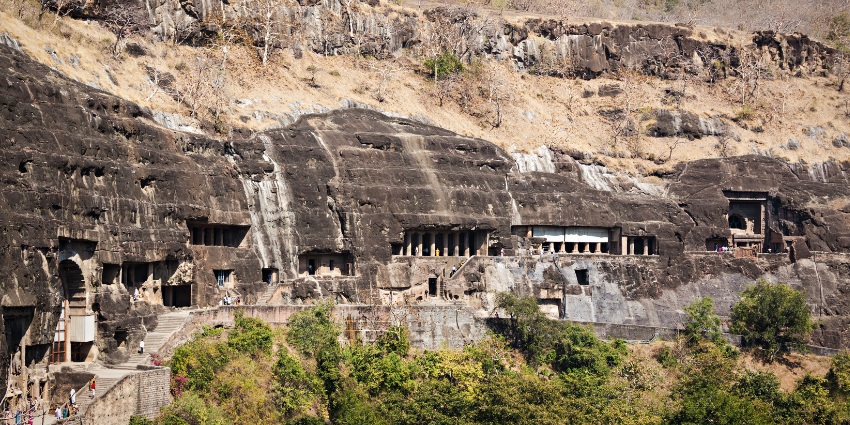
The caves of Ajanta: Buddhist art underground
The Ajanta complex consists of 30 caves cut into a horseshoe-shaped cliff above the Waghora River, about 100 kilometres from the city of Aurangabad. The caves were created in two phases: the first between the 2nd and 1st centuries BC, and the second during the Gupta period, between the 5th and 6th centuries AD.
All the caves at Ajanta belong to the Buddhist tradition. They are divided into two functional types:
- Viharas (monasteries): rectangular halls with side cells where monks lived during the monsoon season. Some include inner shrines with sculptures of the Buddha.
- Chaityas (prayer halls): spaces with rock-cut vaulted ceilings, with a central stupa as the focus of devotion.
What makes Ajanta exceptional is its mural paintings. Caves 1, 2, 16 and 17 hold the largest collection of ancient mural painting in India. The frescoes depict scenes from the previous lives of the Buddha (the Jatakas), with a level of detail and expressiveness that anticipated techniques that would not appear in Europe until centuries later.
The paintings were executed on a layer of plaster applied to the rock, using natural pigments. The darkness inside the caves, paradoxically, helped preserve them: the absence of direct sunlight slowed the degradation of the colours over the centuries.
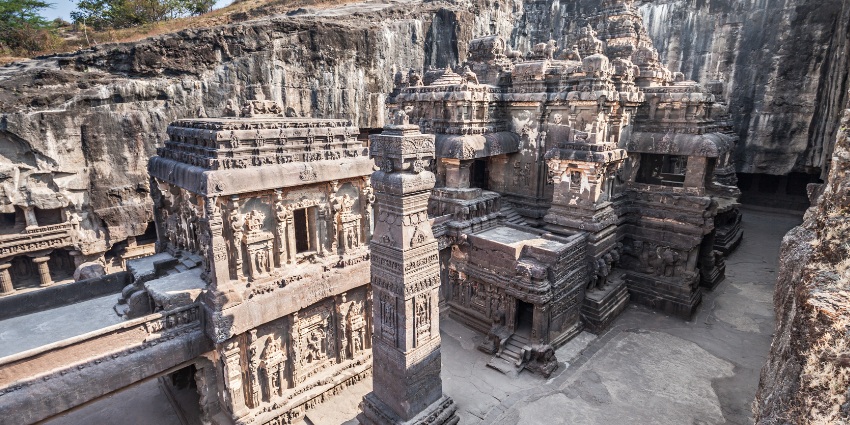
The caves of Ellora: three religions in the same rock
Ellora lies about 100 kilometres north-west of Ajanta and has a very different character. Its 34 caves were excavated between the 5th and 10th centuries AD in a basalt cliff stretching over 2 kilometres.
The fundamental difference from Ajanta is the religious diversity. Ellora brings together temples from three distinct traditions that coexisted in the region:
- Caves 1–12: Buddhist. Multi-storey monasteries with cells, meditation halls and sculptures. Cave 10 (Vishwakarma) stands out for its vaulted ceiling that imitates timber construction, hence its popular name: “the carpenter’s cave”.
- Caves 13–29: Hindu. This is where the Kailasa Temple (Cave 16), the centrepiece of Ellora, is found.
- Caves 30–34: Jain. Smaller and more austere, with detailed sculptures of the Tirthankaras.
This coexistence within a single site is a testament to the religious tolerance that prevailed in the region for centuries. There is no other place in the world where three religious traditions carved their temples side by side in the same rock formation.
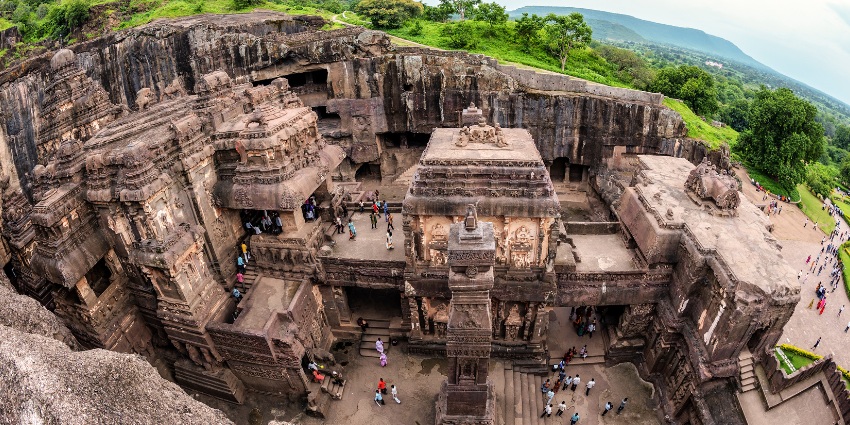
The Kailasa Temple at Ellora (Cave 16) is the largest monolithic structure in the world carved from rock. It is estimated that some 200,000 tonnes of basalt were removed to create it, carving from top to bottom over decades. Nothing was added — everything was created by removing material.
The Kailasa Temple: engineering that defies logic
It deserves a section of its own because it is, arguably, the most ambitious work of rock-cut architecture ever undertaken. The Kailasa Temple was commissioned by King Krishna I of the Rashtrakuta dynasty in the 8th century AD and represents Mount Kailash, the abode of the god Shiva in Hindu mythology.
What is extraordinary is the construction method. Instead of stacking blocks, the craftsmen started at the top of the cliff and excavated downwards, removing rock layer by layer until the structure stood free. The result is a temple 33 metres tall with courtyards, galleries, staircases, columns and monumental sculptures, all carved from a single piece of basalt.
It is estimated that the excavation involved removing approximately 200,000 tonnes of rock. There is no margin for error in such a method: every chisel blow is final. If a column fractures, it cannot be replaced.
The sculptures decorating the temple depict episodes from the Ramayana and the Mahabharata, with figures of gods, demons and mythological animals covering virtually every surface.
Practical information for your visit
Both complexes are near Aurangabad (now officially called Chhatrapati Sambhajinagar), the city that serves as a base for visiting the two sites. Aurangabad has an airport with direct flights from Mumbai and Delhi.
Ajanta:
- Distance from Aurangabad: about 100 km (2 hours by road).
- Opening hours: 9:00–17:30. Closed on Mondays.
- Admission: 600 rupees for foreign visitors (approximately €6.50), 40 rupees for Indian residents.
- Access from the car park to the caves is by government shuttle bus.
Ellora:
- Distance from Aurangabad: about 30 km (45 minutes by road).
- Opening hours: 9:00–17:30. Closed on Tuesdays.
- Admission: 600 rupees for foreign visitors, 40 rupees for Indian residents.
The best time to visit is from October to March, when temperatures are more bearable (between 15 °C and 30 °C). From April to June the heat can exceed 40 °C, and during the monsoon (July–September) rain can make access difficult, although the landscape is at its greenest.
It is possible to visit both sites in two days from Aurangabad, spending a full day at each. Trying to see both in a single day is feasible but exhausting, and does not allow you to appreciate the details of the paintings and sculptures.
If you are interested in discovering more caves with historical and cultural significance across Asia, we recommend our article on the most fascinating caves in Asia, a tour that spans from Vietnam to Turkey.
Frequently asked questions about the caves of Ajanta and Ellora
What is the main difference between Ajanta and Ellora?
Ajanta is exclusively Buddhist and stands out for its mural paintings, the oldest surviving in India. Ellora combines Buddhist, Hindu and Jain temples, and its showpiece is the monolithic Kailasa Temple, a work of rock-cut architecture without parallel in the world. Ajanta is pictorial art; Ellora is sculpture and architecture on a grand scale.
Can you visit Ajanta and Ellora on the same day?
It is possible but not advisable. The distance between the two sites is about 100 kilometres and each complex needs at least 3–4 hours for a reasonably complete visit. The ideal approach is to dedicate a day to each, using Aurangabad as a base.
What do these caves have in common with natural caves such as the Cuevas dels Hams?
They are very different concepts. The caves of Ajanta and Ellora are human excavations in basalt rock, created for religious and artistic purposes. The Cuevas dels Hams in Mallorca are natural formations created by the dissolution of limestone over millions of years. What they share is the fascination that humans feel for underground spaces, whether the work of nature or of our own ingenuity.
Do I need a guide to visit Ajanta and Ellora?
It is not compulsory, but highly recommended, especially at Ajanta. The murals require explanation to understand the scenes depicted, and many caves are dimly lit. An authorised local guide costs between 1,500 and 2,500 rupees (€15–25) per group and makes a notable difference to the experience.