


There are places in the world where nature works with ice instead of stone. Where the walls change colour depending on the time of day and where the landscape you see today may not exist tomorrow. Iceland’s ice caves are exactly that: ephemeral, living formations that the glacier creates and destroys with every season.
Unlike karst caves, which need millions of years to take shape, Iceland’s ice caves form in a matter of months. Meltwater seeps through cracks in the glacier during summer, carving tunnels and chambers beneath the frozen mass, and when winter arrives and temperatures drop, those spaces become accessible. It is a cyclical process: every year the glacier generates new caves and collapses the old ones.
That fragility is precisely what makes them so special. No two visits are ever the same.
Where to find Iceland’s main ice caves
Most of the accessible ice caves are concentrated in the south-east of the island, within or near the Vatnajökull glacier, the largest in Europe. Covering roughly 8,100 km², Vatnajökull blankets about 8 % of Iceland’s landmass and conceals several active volcanoes beneath its ice cap, according to data from the Icelandic Meteorological Office (Veðurstofa Íslands).
The best-known caves form on the glacier tongues that descend from Vatnajökull:
- Breiðamerkurjökull, close to the famous Jökulsárlón glacial lagoon, is the area with the highest concentration of accessible caves. This is where you find the so-called “blue ice caves”, where light filtered through compressed ice produces intense shades of blue.
- Mýrdalsjökull, in the Vík area, is home to the Katla cave, a formation that combines dark ice with volcanic ash trapped during past eruptions. The visual contrast is very different from the classic blue.
- Kötlujökull, another glacier tongue in the south, also produces seasonal caves that vary from year to year.
Access to these caves depends on weather conditions and the state of the glacier. There is no permanent cave: local guides explore every season to locate new formations and assess their safety.
When to visit Iceland’s ice caves
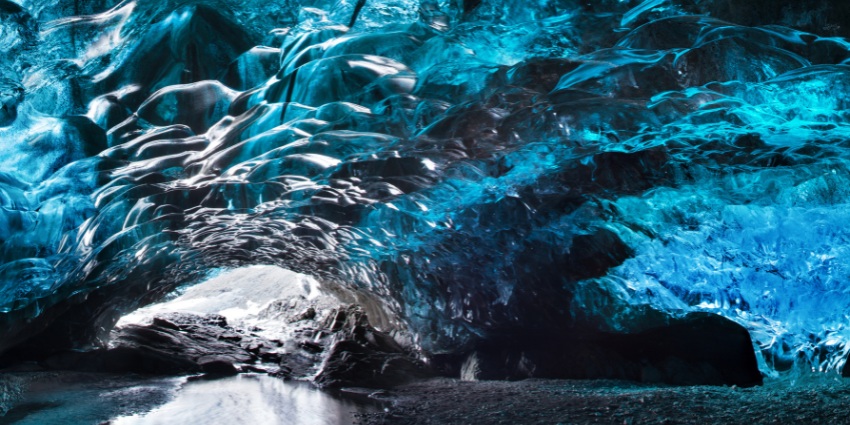
The visiting season runs from November to March, when temperatures stay low enough for the ice structures to remain stable. During these months, the average temperature in south-east Iceland ranges between −5 °C and 2 °C, which reduces the risk of collapse from melting.
Outside that window, the caves become unstable. Meltwater can flood the tunnels within hours, and the ice walls lose their integrity. That is why natural ice caves are closed to the public in summer.
There is a partial exception: the Katla cave, being at a higher altitude and containing layers of volcanic ash that act as insulation, sometimes extends its season into April or May. But there is no guarantee — every year is different.
The best time within the season depends on what you are looking for. In November and December the caves tend to be freshly formed, with smoother walls and more uniform colours. In February and March, natural light begins to penetrate more strongly and creates more dramatic visual effects inside the ice.
Iceland’s ice caves are not permanent. Every winter the glacier forms new caves and the previous season’s disappear. The cave you visit is, quite literally, one of a kind.
How visits are organised and what safety measures apply
All ice-cave visits in Iceland are conducted with certified guides. Entering on your own is not permitted, and doing so is dangerous: the ice can fracture without warning, and conditions inside change rapidly.
Tours usually depart from Jökulsárlón or from the town of Vík, depending on which cave is being visited. Transport to the glacier is by specially equipped off-road vehicles, and the final stretch is covered on foot wearing crampons.
The basic equipment provided by the guiding companies includes a helmet, crampons and, in some cases, a harness. It is advisable to wear thermal layers, waterproof boots and thick gloves. Inside the cave the temperature hovers around 0 °C, but wind chill can make it feel colder if there is a draught.
The average duration of a full excursion, including transport and the walk inside, is 3 to 4 hours. Time spent inside the cave itself is usually 45 minutes to an hour.
One important detail: places sell out weeks in advance during high season (December–February). If you are planning to visit an ice cave, booking at least a month ahead is virtually essential.
Why the ice looks blue
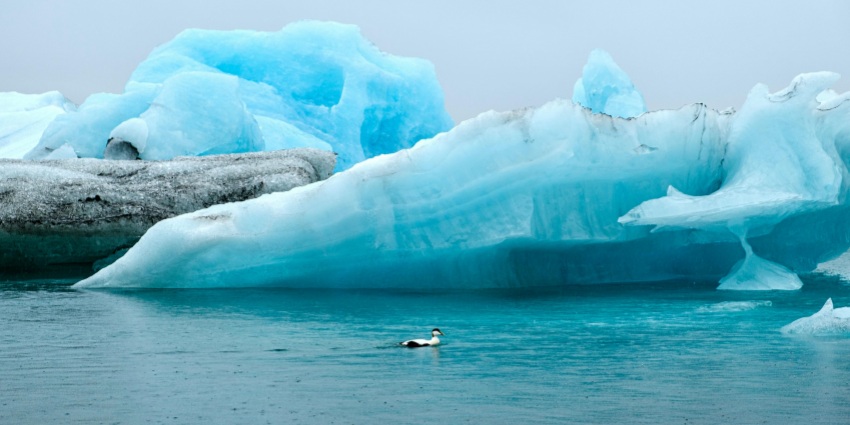
It is one of the most frequently asked questions, and the answer has to do with the density of glacial ice. When snow accumulates over decades and is compressed under its own weight, the trapped air bubbles are gradually squeezed out. The result is extremely dense ice that absorbs most of the visible light spectrum except blue, which is reflected.
The older and more compressed the ice, the more intense the blue. That is why caves formed in the deep layers of Vatnajökull display that distinctive colour, while shallower caves or those containing volcanic ash (like Katla) show shades of grey, black and dark blue.
This phenomenon is not unique to Iceland. It occurs in any glacier in the world with sufficient density. But the combination of accessibility, seasonal formation and volcanic landscape makes Iceland one of the few places where you can see it up close and under controlled conditions.
If you are interested in another example of an ice cave in Europe, we recommend our article on the Eisriesenwelt ice cave in Austria: a frozen world beneath the surface, the largest ice cave on earth and an experience completely different from Iceland’s.
Frequently asked questions about Iceland’s ice caves
What is the best time to visit the ice caves in Iceland?
The season runs from November to March. Within that window, February tends to offer a good balance of stable ice conditions and more daylight hours, which enhances the visual experience inside the cave. Outside the season, the caves are not accessible for safety reasons.
Can you enter an ice cave in Iceland on your own?
No. All visits require a certified guide. Glacial ice is unstable and conditions inside can change within hours. Local guiding companies inspect the caves daily before each departure to confirm they are safe.
What is the difference between Iceland’s ice caves and a karst cave like the Cuevas dels Hams in Mallorca?
The main difference is the material and the timescale. Karst caves like the Cuevas dels Hams are formed by the dissolution of limestone over millions of years, producing stalactites, stalagmites and permanent underground lakes. Ice caves form within months inside a glacier and vanish with the summer thaw. Both are the result of water’s action, but on radically different timescales.
How much does it cost to visit an ice cave in Iceland?
Prices vary by company and cave, but a standard excursion to the blue ice caves of Vatnajökull typically costs between €150 and €250 per person, including off-road transport, safety equipment and guide. Excursions to Katla tend to be slightly cheaper, around €100–150, as they involve less travel.