


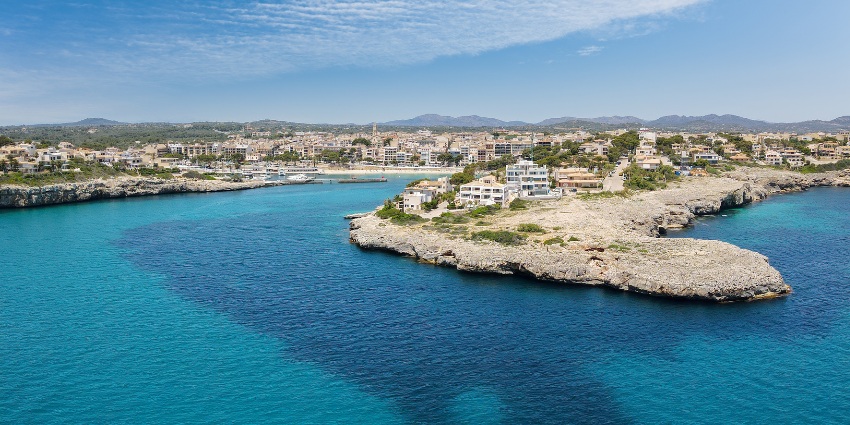
Porto Cristo fits into a single day, and a good part of its charm lies exactly there. It is a harbour town on the east coast of Mallorca, inside the municipality of Manacor, with a sandy beach at the head of the inlet and almost everything else within walking distance.
This guide covers what to see, how much time to give each thing and how to fit it all together: the beach and the harbour, the corners most people walk straight past, the visit to the Cuevas dels Hams, the coves nearby and three ready-made plans depending on who you are travelling with. At the end, how to get there and where to leave the car.
The basics: where it is and how much time you need
Porto Cristo sits on the east coast of Mallorca, 12 kilometres from Manacor and around an hour by car from Palma. The centre is small and easy to cover on foot. Half a morning is enough for the town and the beach; a full day also fits in the Cuevas dels Hams, just outside town and a one-hour visit, plus one of the coves nearby. The beach is around 300 metres long and sits right next to the harbour, so you never have to choose between a swim and a stroll.
What to see in Porto Cristo
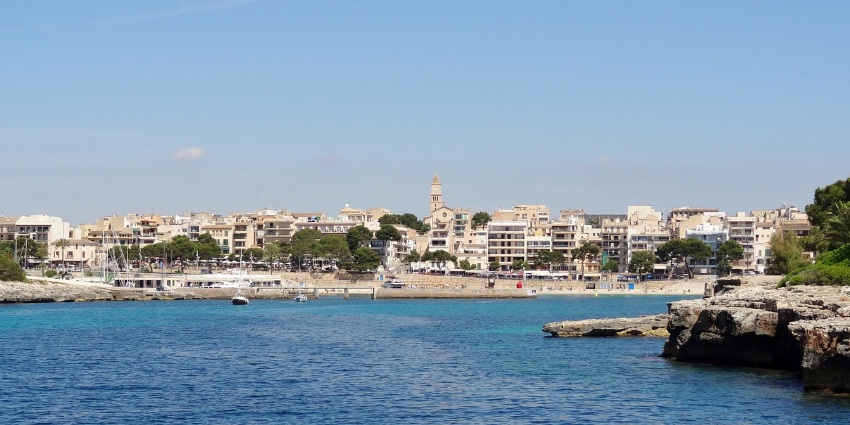
The town grew around its bay and it is still organised the same way. A narrow inlet open to the south-east, two arms of rock closing it almost completely and, at the far end, the beach. Everything else grew around that shape.
The name comes from a landing. Around 1260 a boat reached this cove carrying an image of Christ and another of the Virgin with the Child in her arms, and that is where the place name came from. The official name of the settlement is still Port de Manacor, although hardly anyone uses it.
What you see today is a town with two speeds. In summer the harbour promenade fills up and there are queues at the terraces; the rest of the year it is a quiet place where the fishing boats still come in every morning. If you can choose, May, June and September give you the best version of it.
And it walks well. From the beach to the viewpoint at the headland it is fifteen minutes, and along the way you pass almost everything worth stopping for.
The beach, one of the calm ones
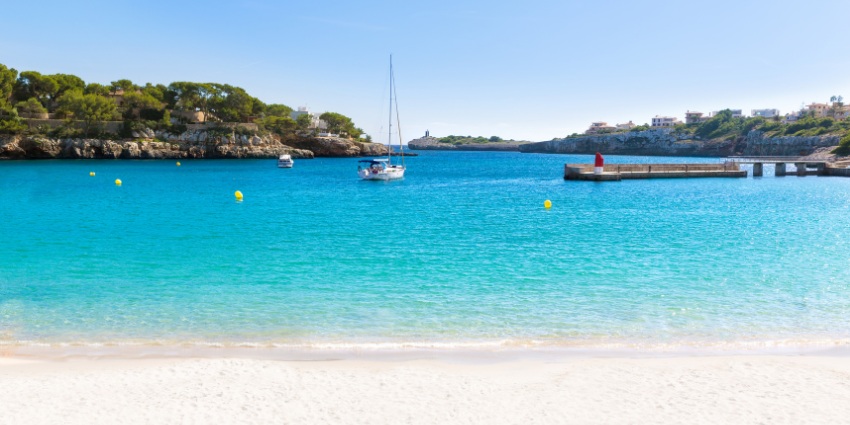
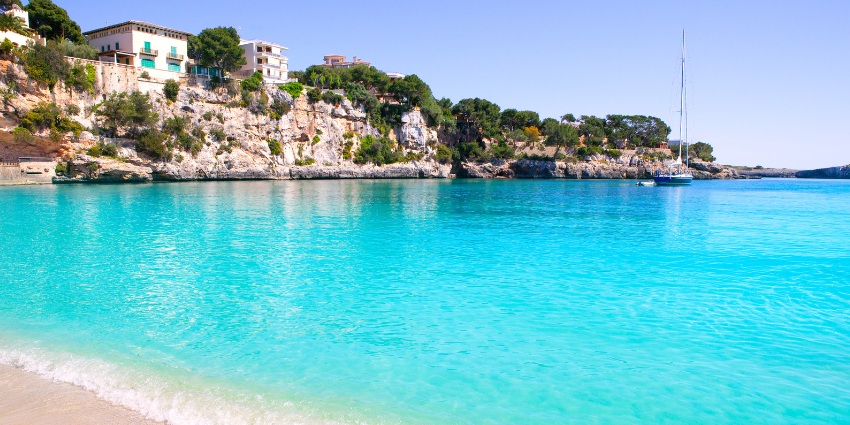
Porto Cristo beach measures around 300 metres long by 30 wide, with fine sand and water that deepens very slowly, according to the Manacor tourist office. Sitting at the head of a sheltered inlet, very little swell reaches it and it is almost always calm.
That makes it one of the easiest beaches on the east coast for swimming with small children. You can walk a long way out without being out of your depth, and there are no currents to worry about.
The other advantage is the location. It is inside the town, with bars, shops and toilets thirty metres from your towel, so you avoid the long walk from a far-off car park that almost every unspoilt cove in the area demands.
The harbour, the promenade and the mermaid
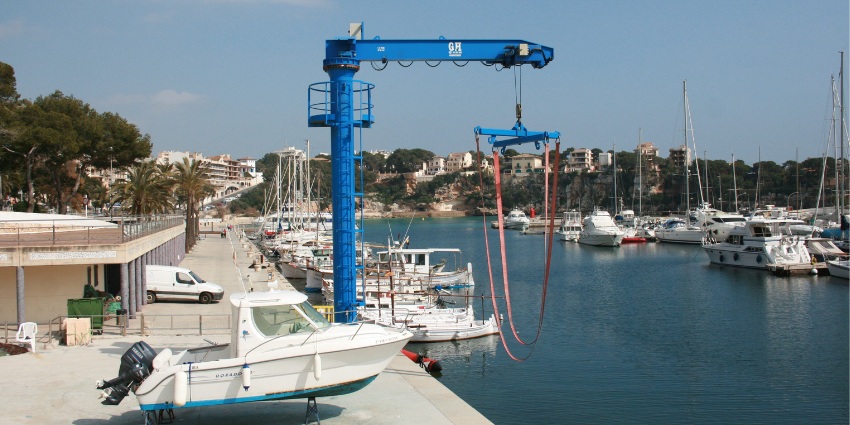
The harbour mixes fishing and leisure boats, and watching it work is part of the plan. The moorings sit on one side of the inlet and the promenade runs the whole length of it, with the beach always in view.
On the Passeig de la Sirena, right in front of the beach, stands the sculpture that gives it its name, the work of Pere Pujol and installed in 1988. It is the town’s meeting point: this is where the activities, the fiestas and the market all happen.
The Torre dels Falcons and the views over the entrance
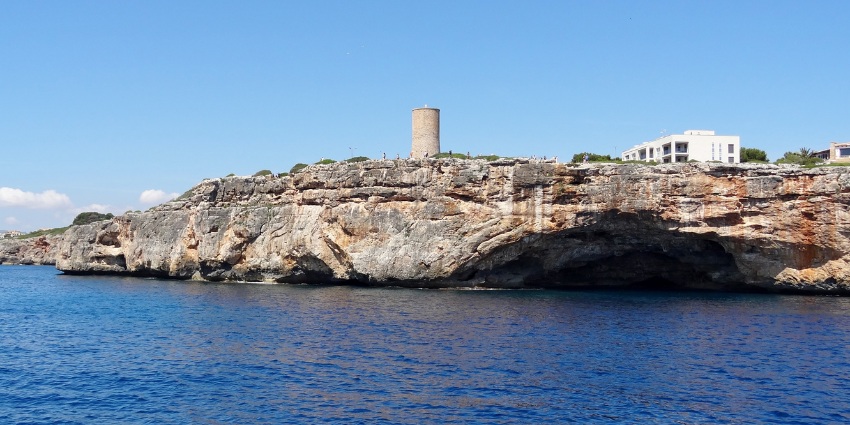
High on the southern side stands the Torre dels Falcons, a 1577 watchtower from which the coast was guarded. The climb is short and the reward is the cliffs that form the mouth of the bay.
It is the best spot in town to understand its shape: from up there you see the whole inlet, the narrow passage the boats come through and Es Morro de sa Carabassa closing it off on the right, with the 1851 lighthouse out at the tip.
An archaeological site almost nobody visits
On the outskirts stands the basilica of sa Carrotja, an early Christian building discovered in 1908, of which the baptismal font, among other things, survives. It is not a spectacular visit and it is not set up as a museum, but it tells you something surprising: there was organised worship here centuries before the current town existed.
If you are travelling with someone who loves history and archaeology, this is the stop that never appears on any list of ten things to do.
The Cuevas dels Hams, the visit that shapes the day
Four kilometres from the harbour, on the Ma-4020 road from Manacor to Porto Cristo, kilometre 11, you will find the Cuevas dels Hams. It is the long visit in the area and the one worth pinning down first, because everything else fits comfortably around it.
The visit lasts exactly one hour and covers around 500 metres on foot through three different caves, with a guide who walks with the group and sets the pace. Entry is by timed slot: you choose your time when you buy the ticket and the group goes in together.
It starts in the Cueva Redonda, which millions of years ago was a closed cavity and today is open to the sky. It is a garden, with unusual vegetation and native birds flying free, and it works as a way into the subject before you really go down.
Next comes the Cueva Azul, where the documentary “Discovering the Past” is screened, about the first inhabitants of Mallorca and the formation of the caves. This stretch holds the Columns of Samson, the Plains of Fra Mauro and the Pit of Hell, and in the auditorium GENESIS is projected, a time lapse running from the Big Bang to the present day onto the rock itself.
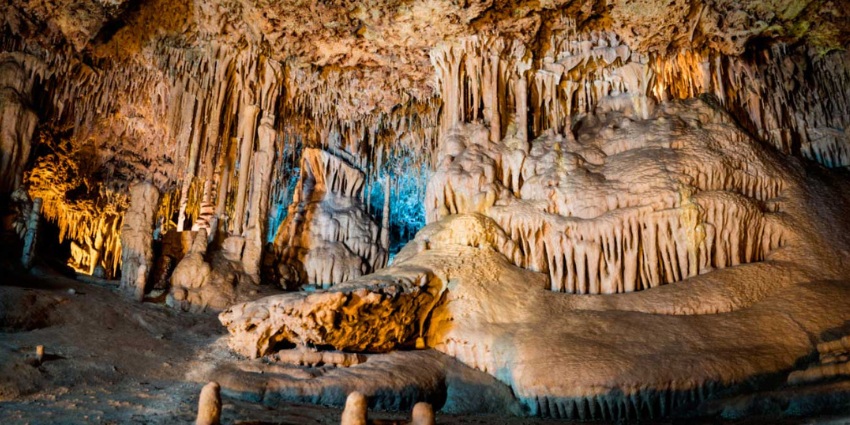
The Cueva Clásica closes the route with twelve galleries, the Hall of the Owls and the underground lake known as the Sea of Venice, where the musical show takes place. The water is completely still and the acoustics of the chamber do the rest. It is the part people remember months later.
The hooks, the reason behind the name
In the chamber called the Angel’s Dream is the formation that gives the cave its name. “Hams” means hooks in Mallorquín, and it is not a metaphor.
They are extremely fine formations that start growing downwards, like any stalactite, and at a certain point curve and grow back up. A hook. If you are curious about how that happens, we explain it calmly in how stalactites and stalagmites are formed.
The practical bit before you book
Inside it is a constant 20 °C all year round. In August, coming straight from the beach, that is very welcome; if you get cold quickly, a long-sleeved layer in your bag is plenty.
The route has 217 steps up and 148 down, with resting points along the way. Worth knowing if there is an older person in the group, and also that pushchairs cannot be taken inside: there is an area next to the ticket office to leave them and there are changing facilities on site. We go into all of this in the guide to visiting the caves with children.
An adult ticket costs €18.50 booked online in 2026, and a child ticket, ages 3 to 12, €12.50. Booking through the website is one euro cheaper per ticket than at the door and you arrive with your time already reserved, which is what really counts in July and August. Prices and all the practical detail are in the article on tickets, opening times and how to get here.
On the same site, fifty metres from the ticket office, is Dinosaurland. The combined Dinos & Caves ticket costs €26 for adults and €20 for children booked online, against the €37 the two adult tickets would cost separately. It is valid for the same day, and it works very well with children: an hour underground and an hour and a half in the open air fit easily into one morning.
Choose your slot at tickets.cuevasdelshams.com and book the time that fits your day best. We open in the morning and close mid-afternoon; the calendar of dates and times is always up to date on dates and opening times.
What to do if you have time to spare
With the town seen and the caves done, there are three things worth doing and one that depends on the day of the week.
The coves nearby
Cala Petita is the closest and can only be reached on foot, along a path of around twenty minutes. It is thirty metres of sand and rock between cliffs, with no services at all, and the seabed is one of the good ones for snorkelling. Take water and closed shoes.
At the other end of Porto Cristo lies Cala Murta, and a little further on Cala Anguila and Cala Mandía begin, these ones with parking and a beach bar. If you prefer long stretches of sand with every service, Cala Millor and Cala Bona are a quarter of an hour north by car.
Getting out on the water
Boat trips leave from the harbour and run along the coast, letting you see the seabed, which around here is clean and shallow close to shore. It is the easiest way to see the cliffs and the coves that no road reaches.
The Sunday market
On Sunday mornings the Passeig de la Sirena fills up with the weekly market: local produce, crafts and the village atmosphere that is more spread out the rest of the week. If your free day falls on a Sunday, start there and leave the beach for after lunch.
Three ready-made plans
Depending on how much time you have and who you are with, this is what works:
- Half a morning (2-3 hours). A walk along the harbour, the climb up to the Torre dels Falcons, a swim at the beach and a drink on a terrace on the Passeig de la Sirena.
- A full day with the family. Cuevas dels Hams first thing, lunch on site or at the harbour, the beach in the afternoon and an ice cream on the promenade. If the children still have energy to burn, the combined ticket adds Dinosaurland without moving from the spot.
- A full day, unhurried. Cuevas dels Hams in the morning, a slow lunch in Porto Cristo, the walk out to Cala Petita and back into town for sunset from the headland.
In all three cases, the trick is to fix the time of the cave visit first and build the rest of the day around it. It is the only thing with a set time.
How to get to Porto Cristo
By car
From Palma you take the Ma-15 towards Manacor and there pick up the Ma-4020 to Porto Cristo. It is around 60 kilometres and about an hour. From the airport it takes practically the same, because it sits on the side of the city where the Manacor road starts and you don’t have to cross Palma.
Parking in town is paid in high season and fills up by mid-morning. It is worth arriving early or leaving the car a little further up and walking down. At the Cuevas dels Hams the car park is right at the entrance and it is free.
By bus
You can get here without a car. The TIB 401 line, Palma to Cala Millor, stops in Porto Cristo and also at the “Dinosaurland-Coves Hams” stop, inside the grounds of the caves. It leaves from the Plaça d’Espanya intermodal station and takes around an hour and a half.
There is no direct line from the airport: first you have to get to Plaça d’Espanya and change there. One piece of advice we always give: if you plan to go back by taxi, arrange it in advance, because in high season there are few in the area and the midday waits get long.
When to go
July and August are the busiest months and also the ones with the longest queues for everything. May, June, September and October strike a better balance: the water is still warm, the beach is quiet and you park without driving in circles.
In winter the town slows down and some of the seasonal businesses close, but the promenade, the tower and the caves are still there. Inside the cave the temperature doesn’t change all year, so it is one of the plans that best survives a rainy day.
If it happens to coincide, 16 July is the feast of the Virgen del Carmen, patron saint of the town, complete with a seaborne procession. It is the day Porto Cristo looks most like itself.
Frequently asked questions about Porto Cristo
What is there to do in Porto Cristo in one day?
Walk the harbour, swim at the beach, climb up to the Torre dels Falcons and visit the Cuevas dels Hams, which take an hour. That gives you a full day without rushing. If you have time left over, the twenty-minute walk to Cala Petita or a boat trip from the harbour are the additions that work best.
Where is Porto Cristo and how do you get there from Palma?
Porto Cristo is on the east coast of Mallorca, in the municipality of Manacor, around 60 kilometres from Palma and about an hour by car via the Ma-15 and the Ma-4020. Without a car, the TIB 401 line from Palma to Cala Millor stops in the town and also inside the grounds of the Cuevas dels Hams.
What is Porto Cristo beach like?
It is around 300 metres long by 30 wide, with fine sand, and the water deepens very slowly. It sits at the head of a sheltered inlet, so it is almost always calm. Being inside the town, you have bars, shops and toilets a few metres away, which is unusual on the east coast.
How long does a visit to the Cuevas dels Hams take?
Exactly one hour, covering around 500 metres on foot through three different caves with a guide accompanying the group. If you also do Dinosaurland with the combined ticket, allow around three hours including the move from one attraction to the other.
How much does it cost to visit the Cuevas dels Hams?
In 2026, an adult ticket costs €18.50 online and a child ticket, ages 3 to 12, €12.50. Booking through the website is one euro cheaper per ticket than at the door and reserves your timed slot. The combined Dinos & Caves ticket is €26 for adults and €20 for children.
Can you visit Porto Cristo with small children?
Yes, and it is one of the easiest places on the east coast to do it. The beach deepens gradually, the promenade is flat and manageable with a pushchair, and the caves have their own guide for families. Bear in mind that pushchairs cannot be taken inside the cave: there is an area next to the ticket office to leave them.
What day is the market in Porto Cristo?
Sunday mornings, on the Passeig de la Sirena, in front of the beach. There is local produce and craftwork, and it is the moment of the week when the town is busiest outside high season.
Is Porto Cristo worth visiting outside summer?
Yes, and for many people that is when it is at its best. You park without driving in circles, the terraces have space and you enjoy the beach without hunting for a gap. The caves stay at 20 °C all year, so the visit doesn’t depend on the weather outside.
The plan almost nobody tells you about
There is one moment of the day in Porto Cristo worth organising everything else around: coming out of the cave in the middle of the afternoon, with the light already low, and walking down to the harbour.
You have just spent an hour with not a single sound from outside getting in, and suddenly there is the water, the boats and the people in front of you. That contrast is the best part of the day, and it costs nothing to set it up properly.
Choose your slot at tickets.cuevasdelshams.com and leave the rest of the afternoon free.