


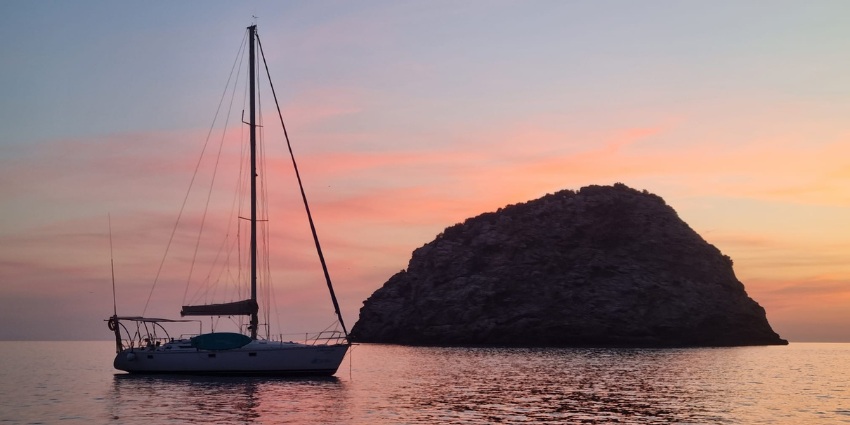
There’s a side of Mallorca you can only see from the water. Cliffs hundreds of metres high, coves no road reaches, lighthouses perched above the sea and a whole island that’s now a national park. For all of that, you need to get on a boat.
This guide covers the island’s most popular boat trips: what you’ll see on each one, how long they take and where they leave from. After that, how to choose between a shared boat and a private sailing boat, when to go and the rules worth knowing before you board.
⛵The most popular boat trips in Mallorca are Port de Sóller to Sa Calobra, Formentor beach from Port de Pollença, Sa Dragonera from Sant Elm, Cabrera National Park from Colònia de Sant Jordi and the catamarans along the east coast. Almost all of them run from April to October and cost between €25 and €70 per adult. If you’d rather skip timetables and crowds, the alternative is a private sailing boat with a skipper.
| Route | Departs from | Duration | Season | Guide price (adult) | Best for |
| Sa Calobra and Torrent de Pareis | Port de Sóller | 1 hour each way | Daily, April to October | €35 return | The Tramuntana cliffs |
| Formentor beach | Port de Pollença or Port d’Alcúdia | 25 min each way | April to October | Check with the operator | A summer beach day without the car |
| Sa Dragonera | Sant Elm | 15 min each way | March to October | Check with the operator | Walking and lighthouses |
| Cabrera National Park | Colònia de Sant Jordi | 3 to 6 hours | Summer season | €45–70 | A full day out |
| East coast by catamaran | Cala Millor, Cala Bona, Porto Cristo, Cala Ratjada | 1 to 4 hours | April to October | From €25 | Families with children |
| Bay of Palma | Palma harbour and nearby | 1 to 2 hours | Summer season | Check with the operator | Anyone staying in Palma |
| Private sailing boat with skipper | Several ports (e.g. Port de Sóller) | Sunset, half day or full day | Summer season | Quote per group | Groups and celebrations |
Why see Mallorca from the sea
From land, you see Mallorca’s coast in pieces: a cove here, a viewpoint there, and miles of road in between. From a boat it all clicks into place, and you find spots that simply don’t exist if you’re driving.
That’s especially true in the north. The Serra de Tramuntana, a UNESCO World Heritage Site since 2011, drops almost straight into the sea, and many of its coves have only two ways in: hours on foot or by boat.
Then there’s the water. In summer it’s above 24 °C, crystal clear along most of the coast, and the Posidonia seagrass on the seabed keeps it clean. Dropping anchor and jumping in the middle of an empty cove is, for a lot of people, the best memory of the whole trip.
The most popular boat trips in Mallorca
Port de Sóller to Sa Calobra, along the Tramuntana coast
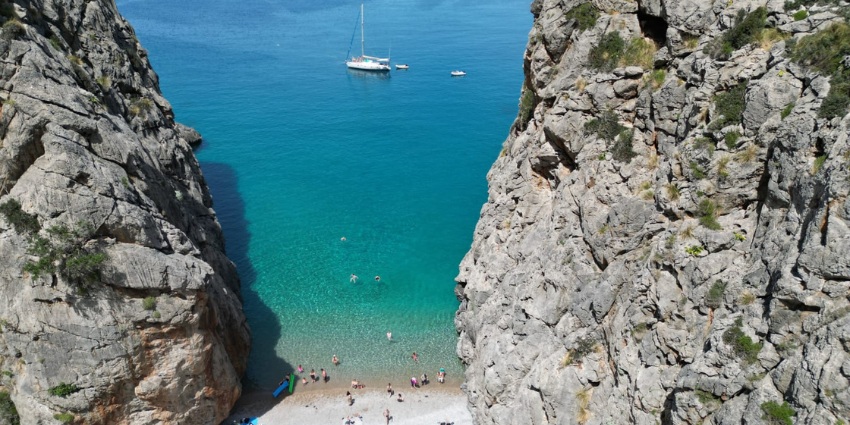
This is the classic route, and probably the most spectacular. The boat leaves Port de Sóller and hugs the Tramuntana cliffs for around seven nautical miles to Sa Calobra, taking about an hour each way.
The destination alone makes it worth it. Sa Calobra is where the Torrent de Pareis meets the sea: a gorge about 3.3 kilometres long with walls up to 200 metres high, declared a Natural Monument in 2003. From the cove you can walk into its final stretch and reach the pebble beach that opens up between the rocks.
The route is run by Barcos Azules, who publish their timetable and prices online. From April to October there are daily departures; in low season, only on Tuesdays and Saturdays. The published adult fare is €35 return and €23 one way, with a discount if you book online. A popular option is to go out by boat and come back by car or bus along the Sa Calobra road, or the other way round.
Port de Pollença to Formentor beach
At the island’s northern tip you can drive the Formentor peninsula, but in summer there’s a catch. In 2026, access to the lighthouse was restricted from 15 May to 18 October, 10:00 to 22:00, according to Spain’s traffic authority, the DGT, and the beach car park fills up early.
That’s why the boat makes so much sense. Small boats leave Port de Pollença for Formentor beach and take about 25 minutes, from April to October, crossing the bay with the mountains behind you. There are also departures from Port d’Alcúdia to the cape and the beach.
Formentor beach is long and narrow, with pine trees almost down to the water and a very calm sea. Going by boat means you can spend the whole day there without worrying about where to leave the car.
Sa Dragonera from Sant Elm
Off Mallorca’s south-west tip, across a channel about 800 metres wide, lies Sa Dragonera. Its long silhouette, like the back of a dragon, can be seen all along the Andratx coast, and it has been a Natural Park since 1995.
The boat leaves from the jetty in Sant Elm and crosses in about 15 minutes, usually from March to October. There are no cars on the island and no facilities beyond the park’s own: footpaths, three lighthouses (Tramuntana, Llebeig and the Far Vell, at the highest point) and thousands of Balearic lizards, found only on these islands, which walk right up to you without a hint of fear.
According to the Balearic Government, the park is open from 10:00 to 16:30 on weekdays during the May to October season, and until 18:00 at weekends. Wear proper shoes and bring water: the paths to the lighthouses are rocky and there’s no shade. We cover it in more detail in our guide to Sa Dragonera.
Cabrera, the national park in the south
About ten nautical miles from Colònia de Sant Jordi lies the Cabrera archipelago, a Maritime-Terrestrial National Park since 1991. It’s the most complete boat trip in Mallorca: almost a full day of sailing, swimming and walking on the island.
Boats leave Colònia de Sant Jordi in season, with several authorised companies and trips lasting from around three hours to around six. Published prices for 2026 are roughly €45 to €70 per adult, depending on the length of the trip and the type of boat.
On land, Cabrera has a grim past. Between 1809 and 1814, after the Battle of Bailén, the island was used as a prison for thousands of French soldiers, and only some of them ever made it home. A monument remembers them on the self-guided route “Un paseo por la historia” (A walk through history), about 3 kilometres long.
If you’re sailing on your own, you need a free navigation permit and must moor to the park’s buoys: anchoring is not allowed in Cabrera.
The east coast: coves, seabeds and catamarans
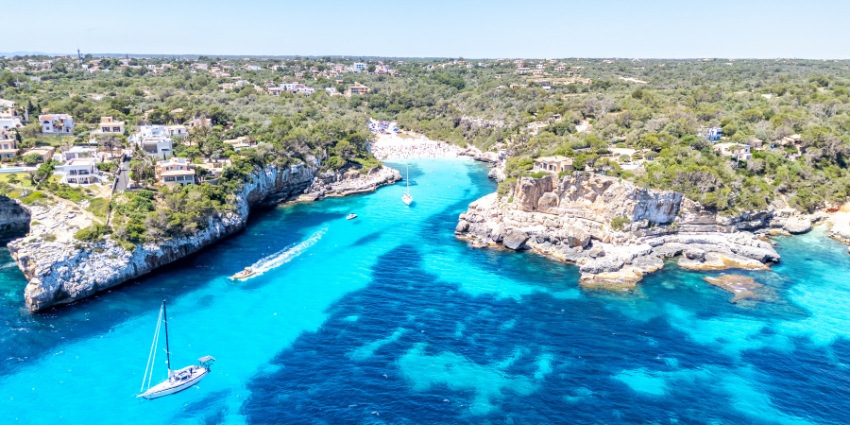
Between Cala Ratjada and Cales de Mallorca, you can explore the east coast on catamarans with underwater viewing. They leave from Cala Millor, Cala Bona, Sa Coma, Porto Cristo and Cala Ratjada, among other ports, from April to October, on routes of one to four hours, with prices from around €25 per adult.
It’s the most family-friendly trip on the island. The boat goes slowly, close to the shore, you can watch the fish through the hull without getting wet, and the longer routes stop for a swim. The coves here are lower and more open than in the north, with turquoise water and pine trees right down to the shore.
If you like this stretch of coast, it’s worth seeing from land too. Many of its coves can be reached on foot, and our guide to Porto Cristo shows you how to plan a full day in the town.
The Bay of Palma
The easiest option if you’re staying in or around Palma. Catamarans leave from Palma harbour and nearby spots such as Can Pastilla and Magaluf, on trips of one to two hours.
The best part is the way back. From the water you see the cathedral above the old city walls, the old town behind it and the Serra de Tramuntana in the distance, a view you simply can’t get from land.
Private sailing boat with a skipper: another way to do it
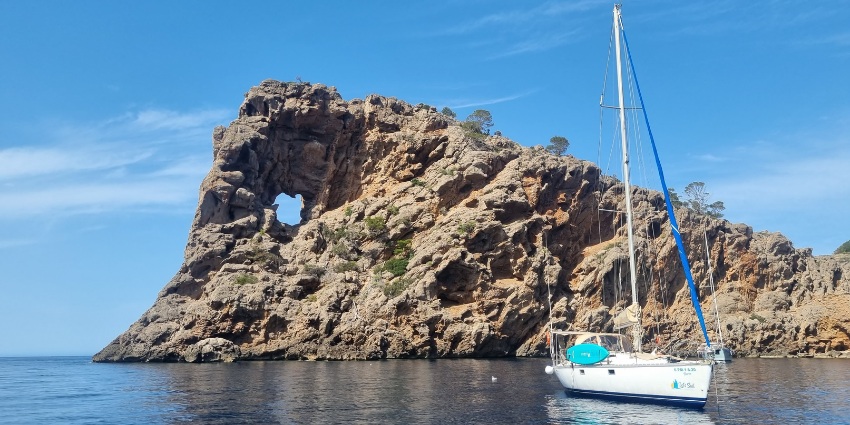
Scheduled boats have fixed times, set routes and, in summer, quite a few people on board. If you’re after the opposite, the alternative is a private sailing boat with a skipper: the boat just for your group, the route built around what you feel like doing, and anchoring wherever it’s quietest.
There are usually three options: full day, half day and sunset. They normally include the skipper, fuel and snorkelling or paddleboard gear, and you don’t need any sailing experience.
On the north coast, for example, Let’s Sail sails from Port de Sóller with groups of up to eight people to Sa Calobra or, at sunset, towards Deià. It’s a good choice for a celebration or for anyone who wants the Tramuntana without the crowds.
How to choose your boat trip
The first question is how much time you have. A morning is enough for the Bay of Palma, Formentor or a catamaran along the east coast. Sa Calobra needs a good half day, and Cabrera the whole day.
Next, who you’re going with. With small children, short trips and boats with underwater viewing work best. As a couple or with friends, a private sailing boat or the Sa Calobra route gets more out of the day. If you like walking, Sa Dragonera and Cabrera combine the boat with a hike.
And finally, where you’re staying. Mallorca is bigger than it looks: from Porto Cristo, for example, it’s about an hour’s drive to Colònia de Sant Jordi, about an hour and a quarter to Port de Pollença and over an hour and a half to Port de Sóller. Choosing the trip that leaves closest to your hotel saves you half a morning on the road.
When to go and what to bring
Almost all trips run from April to October. July and August have the warmest water, above 24 °C, but also the busiest boats. June and September are the sweet spot: the sea is still warm, there’s space on board and the light is better for photos.
In low season there are fewer sailings and more depends on the weather. If you’re travelling outside the summer, always check the departure days before planning your day.
Before you board, have these to hand:
- Sun cream, a cap and sunglasses. The sun is stronger out at sea than it feels, and there’s hardly any shade.
- Swimsuit on and a towel. Almost every route stops for a swim.
- Something warm for the way back. It gets cooler mid-afternoon once the wind picks up.
- If you get seasick, sit in the middle of the boat and look at the horizon. Bigger boats and the calmer morning sea are easier going.
- Water and something to eat on longer trips, although many boats have a bar.
Rules worth knowing
The seabed around the Balearic Islands is covered in Posidonia seagrass meadows, a plant that cleans the water and protects the beaches. Since Decree 25/2018 it has been forbidden to anchor on it: if you hire a boat, you have to drop anchor on sand or use the buoys in the mooring fields.
There are rules for dolphins too. Spanish law on cetacean protection means you can’t get closer than 60 metres, can’t go faster than 4 knots near them and must approach in parallel, never head-on. Some trips offer dolphin watching, but none can guarantee a sighting.
And on land, the other side of the coast
Mallorca’s sea has an underground side. The same limestone that forms the cliffs and coves hides caves below ground that water has been shaping for millions of years.
If you’re doing a trip on the east coast, the Cuevas dels Hams are four kilometres from the harbour in Porto Cristo. The visit takes an hour and ends at the Mar de Venecia underground lake, with its musical show, after passing through the Sueño de un Ángel chamber, home to the hook-shaped formations that give the cave its name.
Sea in the morning, underground in the afternoon: an easy day to plan from anywhere on the east coast.
Frequently asked questions about boat trips in Mallorca
What’s the best boat trip in Mallorca?
It depends on what you’re looking for. Port de Sóller to Sa Calobra is the most spectacular, thanks to the Tramuntana cliffs; Cabrera is the most complete; and the east coast catamarans are the easiest with children.
How much does a boat trip in Mallorca cost?
East coast catamarans start at around €25 per adult. The boat from Sóller to Sa Calobra has a published fare of €35 return, and trips to Cabrera cost between €45 and €70. Private sailing boats are quoted per group.
How long is the boat from Sóller to Sa Calobra?
About an hour each way, covering around seven nautical miles along the cliffs of the Serra de Tramuntana. There are daily departures from Port de Sóller between April and October.
Can you get to Formentor by boat?
Yes. Boats leave Port de Pollença for Formentor beach and take about 25 minutes, from April to October, and there are also departures from Port d’Alcúdia. It’s the easiest way to get there in summer, when car access is restricted.
When is the best time of year for a boat trip?
June and September. The water is warm, there are fewer people than in July and August and the sea is usually calm. Most trips run from April to October.
Are there boat trips to see dolphins in Mallorca?
Yes, especially from the Bay of Alcúdia, and a resident population of bottlenose dolphins has been studied around Cabrera. No company can guarantee a sighting, and the rules require you to keep at least 60 metres away.
The sea, at your own pace
The Mallorca you see on postcards is meant to be seen from the water. A boat takes you to the cove that isn’t on the maps, in front of a cliff you can’t photograph from above, or to an island where the lizards come over to say hello.
Pick the route that fits your trip, book early in summer and save some time for what lies beneath. If you’re on the east coast, choose your ticket at tickets.cuevasdelshams.com and finish the day underground.